
Contact Us
-
-
4.9/5525 user rating


The Hollimon Firm provides legal representation for criminal defense and personal injury cases. From drug crimes, DUI/DWI, assault, and traffic violations to car accidents, truck accidents, slip and fall injuries, and wrongful death claims, our firm helps clients protect their rights and move forward with confidence.
A gun charge in Towson, MD carries mandatory prison time and a permanent mark on your record. I am a local criminal defense attorney who challenges how the firearm was found and whether the police followed the law.

I am Justin Hollimon, a gun crime attorney and former Assistant Public Defender with hundreds of criminal trials behind me. I hold a license to practice in the U.S. District Court for the District of Columbia, which lets me defend firearm charges in both D.C. Superior Court and federal court. You work with me directly on every gun crime case, from the first phone call through the final verdict.
Satisfied Client
You get a firearm defense attorney who handles your case personally and knows both court systems that prosecute weapons charges in Towson. Most firms pass these cases to junior associates who treat them as routine. I take the opposite approach and give your defense my direct attention at every stage.

The District of Columbia and the federal government both prosecute firearm offenses, and the venue shapes the penalty you face. Possession charges, theft charges, and weapons enhancements each carry their own statute and their own defense path, while sex crimes require an equally distinct approach. The charge against you depends on your record, how the gun was found, and whether the case stays local or moves to federal court. I review which statute applies to your arrest and whether the evidence actually supports it.
Possession of a gun by a convicted felon violates D.C. Code § 22-4503 and carries a mandatory minimum of one year in prison. The maximum climbs to 10 years, and a prior crime of violence pushes the mandatory minimum to three years. The law also bars firearm possession for anyone under a protective order or with a recent domestic offense. I challenge whether the state can prove you knew the weapon was present.
A federal felon in possession charge under 18 U.S.C. § 922(g) exposes you to up to 10 years in federal prison and a fine reaching $250,000. Three prior violent or serious drug convictions trigger the Armed Career Criminal Act, which forces a 15 year mandatory minimum. Federal prosecutors win these cases by proving knowing possession. I defend felon firearm possession charges at the federal level where the stakes run highest.
Constructive possession of a gun lets prosecutors charge you for a firearm you never physically held. The state argues you had dominion or control over the space where police found the weapon, such as a car or a shared room. This theory often sweeps up passengers and roommates who had no connection to the gun. I expose the missing fingerprints and DNA that the prosecution needs to make this charge stick.

Carrying a pistol without a license violates D.C. Code § 22-4504 and brings up to five years in prison for a first offense. A second degree gun possession charge or a prior felony raises that exposure to 10 years. The arrest usually follows a traffic stop or a street encounter where police claim to see a weapon. I scrutinize whether the officer had legal grounds for the stop that led to the search.
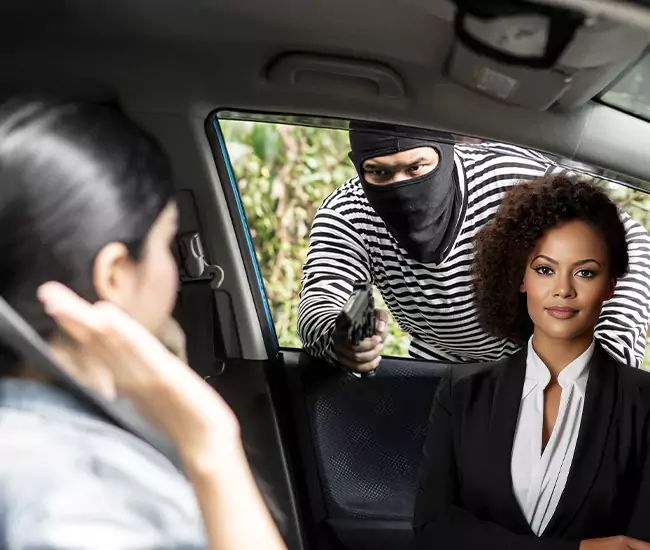
Pointing a gun at someone can support an aggravated assault charge when prosecutors allege you threatened serious harm. Assault by pointing treats the firearm as the instrument of the threat, which adds a weapons enhancement under D.C. Code § 22-4504(b). A conviction for possessing a firearm during a crime of violence carries up to 15 years with a mandatory minimum. I separate a real threat from a misread gesture or a self-defense situation.
Gun theft charges arise when the state alleges you took a firearm that belonged to someone else. Charges for stealing a gun often pair with a theft by receiving stolen property gun count under D.C. Code § 22-4503(c-1). That receiving charge carries two to five years in prison even when you never stole the weapon yourself. I challenge whether you knew or had reason to know the firearm was stolen.
Conspiracy to supply firearms charges target an agreement to move guns rather than a single sale. Prosecutors build these cases on informant statements, recorded calls, and circumstantial links between people. The conspiracy charge stacks on top of the underlying weapons counts and multiplies your sentencing exposure. I attack the reliability of the informant and the proof that you actually joined any agreement.
Juvenile gun possession cases move through D.C. Family Court, where the focus shifts toward rehabilitation over incarceration. A firearm finding still creates a record that can follow a young person into adulthood and affect college or job prospects. Quick action protects diversion options that disappear once a case advances. I work to keep a single mistake from shaping a child's entire future.
Owning a gun with a domestic violence conviction is unlawful under both D.C. Code § 22-4503 and federal law for five years after an intrafamily offense. A protective order alone can strip your right to possess a firearm before any conviction. Many people face this charge without knowing their prior case triggered the ban. I examine whether the underlying conviction actually qualifies under the statute.
A non violent felony conviction still costs you the right to possess a firearm under federal law, which draws no line between violent and non violent offenses. That means an old fraud or drug case can support a fresh gun charge years later. Recent constitutional rulings have opened new challenges to this lifetime ban. I raise those arguments to fight a possession charge built on a distant conviction.
Do not wait to reach out to my office. The sooner you contact me, the sooner I can begin reviewing your case and explaining your legal options. Time is critical in many legal matters, especially criminal defense, so call my office at (410) 319-2038 to schedule a confidential consultation.



Bring every document you received at your arrest, including the charging papers, your release conditions, and any court dates listed on your paperwork. If you have text messages, photos, or names of people who saw the arrest, bring those too. Justin Hollimon reviews all of it during your consultation to find what helps your defense and what the prosecution plans to use against you.
A misdemeanor firearm case in Towson often resolves in 3 to 6 months depending on the court schedule and whether a plea or diversion agreement comes early. Felony gun charges take longer, usually 12 to 18 months, because they involve grand jury proceedings and detailed evidence review. Justin Hollimon keeps you updated at every stage so you never wait without answers.
Yes. The Office of the Attorney General sometimes offers a diversion agreement on a misdemeanor firearm case, which ends in dismissal once you complete the conditions. A deferred prosecution agreement lets you avoid a guilty plea entirely while the case stays open. Justin Hollimon pushes for these outcomes early, before prosecutors commit resources that make them less willing to negotiate.
You can still face charges under constructive possession law even when the firearm did not belong to you. Prosecutors use this theory to charge passengers in a car or people in a shared space where a gun turns up. Justin Hollimon challenges that argument by showing the absence of fingerprints, DNA, or any direct link between you and the recovered weapon.
A firearm conviction creates a permanent record that employers and licensing boards see during background checks. Federal jobs, security clearances, and many professional licenses face direct risk from a single conviction. Anyone who pleads guilty to a gun offense also lands on the D.C. gun offender registry. Justin Hollimon fights to reduce or dismiss your charges specifically to protect your career.
No. Anything you say after a firearm arrest gets recorded and used against you in court, no matter how innocent your explanation sounds. The most important step you take is contacting a defense attorney before you make any statement to law enforcement. Contact The Hollimon Firm at (410) 319-2038 so Justin Hollimon steps in to protect your rights right away.